Four real situations from paper trading in 2026. They show how CT Products works, not promised returns.
A VWAP and EMA strategy, written in plain words, tested on 132 trades
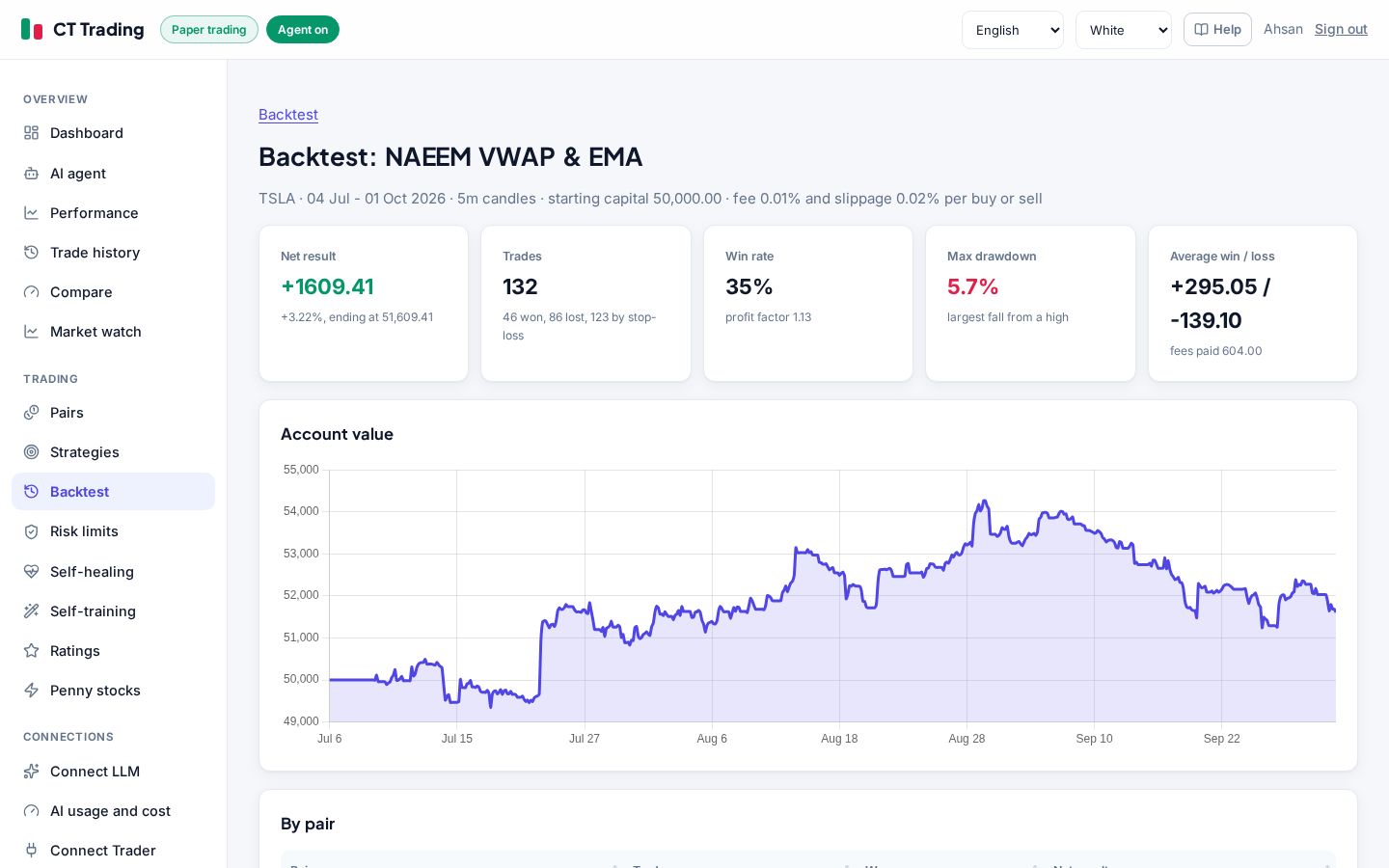
Backtest · Tesla (TSLA) · 5-minute candles · 4 July to 1 October 2026 · practice capital 50,000 USD · fees and slippage included
132trades
+1,609USD net (+3.2%)
35%win rate
1.13profit factor
5.7%largest drawdown
The idea. A trader described his intraday method in a few paragraphs: trade in the direction of VWAP and a rising EMA, enter on a reclaim, stop at a multiple of the average range, take profit at twice the risk.
What the agent did. It turned the story into rule cards and noted what the rules could not express. The backtest then replayed the rules on three months of Interactive Brokers prices, charging fees on every trade.
What it showed. A small profit with a low win rate: winners averaged about twice the losers. The drawdown and fee cost were visible before a single real trade, which is exactly what a backtest is for. The next step was to let the AI test improvements on unseen prices.
The backtest page for this strategy.
A stop-loss too close to the price, caught before it cost money
Paper trading · Exness · BTCUSD · 2-minute candles
The problem. A fast strategy on 2-minute candles placed its stop-loss only 0.11% from the price. At that distance, fees and the spread take most of each trade.
What happened. The broker's risk limits require a stop at least 0.3% away, so the trade was blocked and recorded as an issue. The issue came with a suggested fix: stop-losses based on the market's normal range (1.5 × ATR) on both buy and sell sides, and 15-minute candles.
The result. The trader clicked Apply fix. The old version was kept for roll back, and the backtest page opened to check the change before real money.
Learning from the losses
Paper trading · all strategies · Learn from losses and self-healing
The situation. Several strategies had a run of stop-loss hits in the same week.
What the agent did. One click on Trade history made it study every losing trade with its stop-loss distance, the reason it closed and the AI's review of each loss. For each strategy it proposed better rules and backtested them on a learning period and on prices it had never seen.
The rule that keeps it honest. Only ideas that beat the current rules on past prices and were not worse on unseen prices are marked best. Paper strategies can take them automatically; real-money strategies always wait for the trader's approval.
Three brokers, separate limits, one view
Paper trading · Binance, Interactive Brokers, Exness
The setup. Crypto pairs on Binance, US stocks on Interactive Brokers and gold and bitcoin on Exness, each with its own strategies.
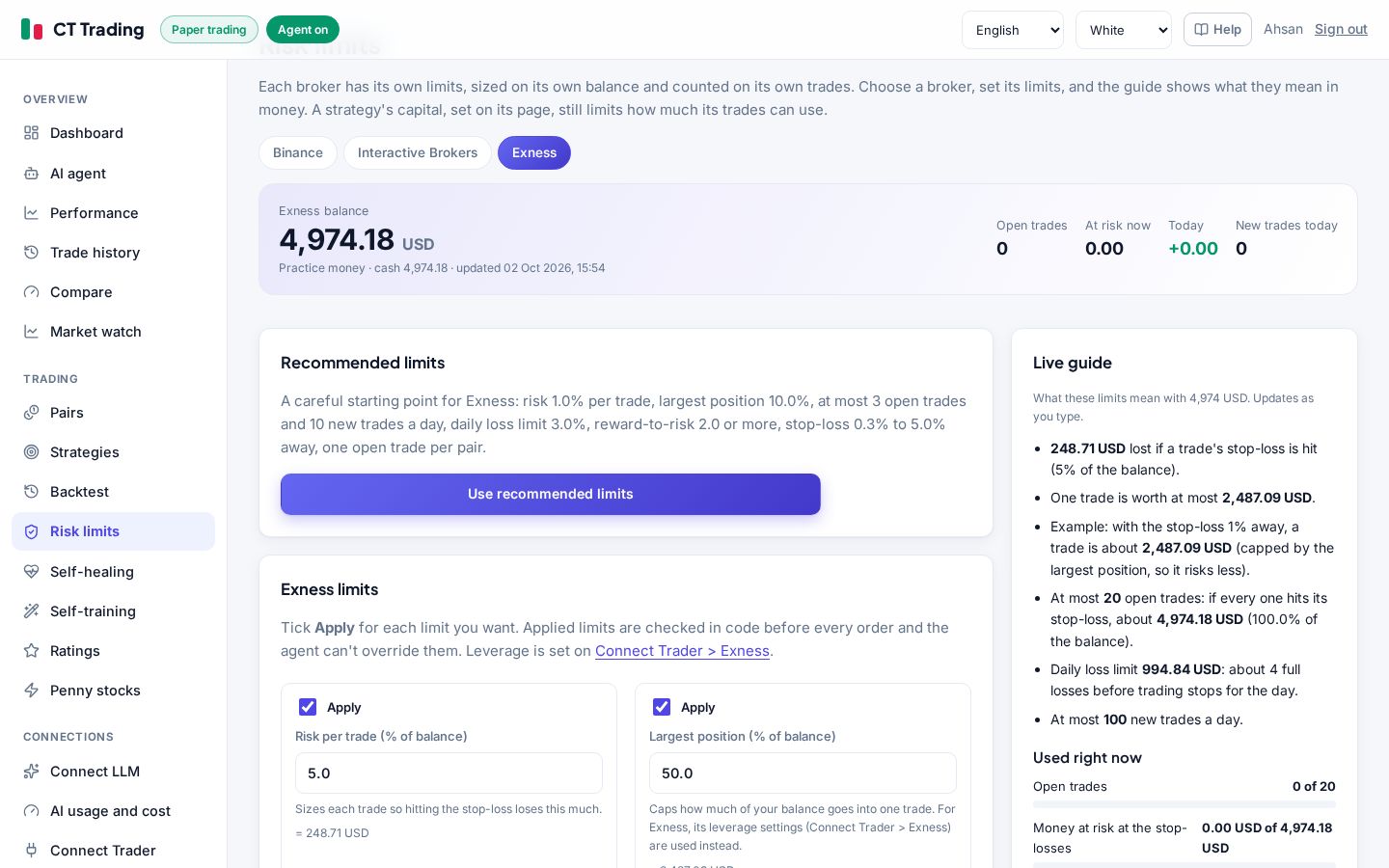
The difference. Each broker got its own risk limits on its own balance. On the 4,974 USD Exness practice account, 0.5% risk per trade meant about 24.87 USD lost if a stop was hit, and the live guide showed the worst case with every open trade before saving.
Risk limits for Exness, with the balance and live guide.
All four cases come from our own paper-trading tests with practice money. Backtests show how rules behaved on past prices; they do not predict future results.
See it with your own strategy
Start on practice money for 14 days. No card needed to look around.